Best Cyber Insurance for Photographers and Content Creators in 2026
Photographers and content creators operate digital businesses, even when much of their work happens behind a camera. Client photographs are stored on computers, online galleries and cloud platforms. Payments arrive through digital services, while bookings, contracts and customer conversations are managed through websites and email.
This dependence on technology creates risks that traditional photography insurance may not fully cover.
A stolen camera is normally treated as a property loss. A stolen client database, ransomware attack or hacked cloud gallery is a different type of event. Recovering from it may involve computer experts, legal advice, customer notifications, credit monitoring and lost business income.
Cyber insurance is designed to help businesses manage some of these costs. It may cover the insured business’s own losses and claims brought by customers or other third parties.
However, cyber policies are not identical. Coverage limits, exclusions, security requirements and definitions can vary considerably. A cheap policy may provide little help for the specific technology used by a photographer or creator.
This guide explains cyber insurance for photographers and content creators in 2026. It covers common risks, important coverage, possible exclusions, application questions and ways to select a suitable policy.
This article provides general information, not insurance, financial or legal advice. Policy wording and insurance requirements differ by company, state and country. Review the complete policy with a licensed insurance professional before purchasing coverage.
Quick Overview of Cyber Insurance for Creators
| Question | Short answer |
|---|---|
| Do photographers need cyber insurance? | It may be valuable if they store client information, accept online payments or rely on digital files |
| Does general liability cover data breaches? | Often not; cyber risks may require separate coverage or an endorsement |
| Can cyber insurance cover ransomware? | Some policies can cover response and recovery costs, subject to conditions and exclusions |
| Does it cover deleted photographs? | It may cover data restoration after a covered cyber event, but not every accidental deletion |
| Can it cover a hacked cloud provider? | Some policies include incidents involving approved vendors and third parties |
| Is professional liability the same as cyber insurance? | No. Professional liability generally addresses errors in services, while cyber insurance addresses defined digital and privacy events |
| Will insurance pay any ransom demand? | Not automatically; prior approval, legal restrictions and policy conditions usually apply |
| Does insurance replace cybersecurity? | No. Insurers may require security controls, and prevention remains essential |
| Is cyber insurance expensive? | Pricing depends on revenue, data, coverage limits, claims history and security controls |
| Should creators compare more than price? | Yes. Coverage definitions, sublimits, exclusions and response services are critical |
Why Photographers Face Cyber Risks
A photographer’s most valuable assets are not limited to cameras, lenses and lighting equipment. Digital files and access credentials can be equally important.
A photography business may hold:
- Client names and addresses
- Email addresses
- Phone numbers
- Signed contracts
- Payment records
- Wedding photographs
- Images of children
- School portraits
- Identification photographs
- Private property images
- Event guest lists
- Model releases
- Login credentials
- Unpublished commercial campaigns
- Cloud-gallery access links
Some of this information is sensitive or personally identifiable. A breach can affect clients even when payment-card numbers are processed by a separate provider.
Content creators also manage valuable digital assets, including:
- Unpublished videos
- Sponsorship agreements
- Brand campaign files
- Social media credentials
- Advertising accounts
- Subscriber information
- Affiliate dashboards
- Course materials
- Revenue reports
- Mailing lists
- Original scripts and photographs
A hacked account can interrupt revenue immediately. A creator may lose access to a monetized channel, have fraudulent advertisements published under their name or receive fake payment-change requests.
Common Cyber Incidents Affecting Photographers
Ransomware
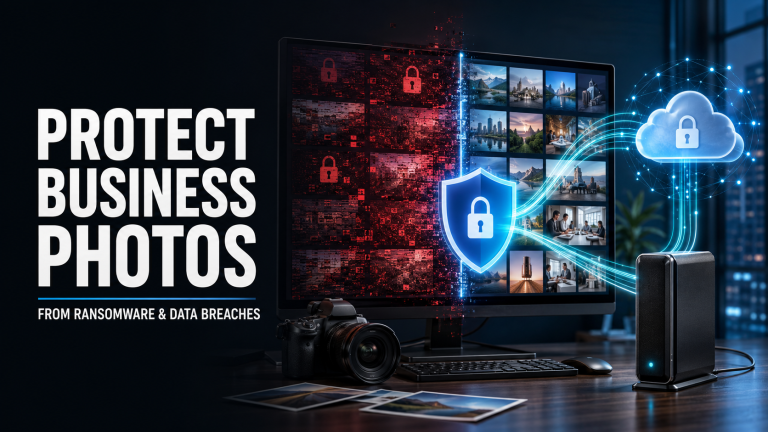
Ransomware encrypts data or blocks access to systems. Attackers may demand payment in exchange for a decryption key or a promise not to publish stolen information.
A photographer could lose access to current client galleries, booking documents and years of archived work. Even when a ransom is paid, recovery is not guaranteed.
The U.S. Cybersecurity and Infrastructure Security Agency recommends maintaining offline, encrypted backups and regularly testing recovery.
Business Email Compromise
An attacker gains access to an email account or convincingly impersonates a business. The criminal may send false invoices, change bank details or request urgent payments.
Photographers and creators frequently work with clients and brands through email, which can make fraudulent payment instructions appear believable.
Cloud Account Takeover
A stolen password may provide access to cloud storage, client galleries or shared project folders. Attackers can copy, delete or expose private images.
Reusing passwords across email, storage and social platforms increases this risk.
Phishing
A phishing message attempts to persuade someone to reveal credentials, approve a login or download malicious software.
Creators often receive unsolicited sponsorship proposals, media files and collaboration links. This makes it easier for a malicious attachment to resemble legitimate business communication.
Website Attack
A compromised WordPress site or online store can redirect visitors, steal form submissions or distribute malware. The business may also lose search visibility while the problem is resolved.
Social Media Account Theft
A creator’s audience may be a significant business asset. An attacker can change account-recovery information, publish scams and demand money to return control.
Accidental Disclosure
Not every data incident is a sophisticated attack. A photographer might send a private gallery to the wrong client, make a folder public or include hidden personal information in shared files.
Stolen Equipment
A stolen laptop or unencrypted external drive can become a privacy incident when it contains client information.
Equipment insurance may replace the hardware but not necessarily cover legal and notification costs arising from exposed data.
Vendor Breach
Photographers depend on cloud-storage providers, gallery services, website hosts, email platforms and payment processors. An attack against one of these vendors may affect the business’s clients.
The Federal Trade Commission recommends asking whether a cyber policy covers attacks on data held by vendors and other third parties.
What Is Cyber Insurance?
Cyber insurance is a type of business insurance designed to address certain losses caused by digital attacks, data breaches and privacy incidents.
The National Association of Insurance Commissioners explains that policies may include first-party coverage, third-party coverage or both.
First-Party Coverage
First-party coverage addresses defined losses suffered directly by the insured business.
Examples may include:
- Incident-response costs
- Digital forensic investigation
- Data restoration
- Business interruption
- Ransomware response
- Cyber extortion
- Public-relations support
- Legal consultation
- Customer notification
- Credit monitoring
- Fraudulent transfer
- Hardware replacement under limited circumstances
Third-Party Coverage
Third-party coverage addresses claims and legal responsibilities arising from harm allegedly caused to clients or other parties.
Examples may include:
- Privacy lawsuits
- Regulatory investigations
- Legal defence
- Settlements
- Judgments
- Contractual privacy claims
- Media liability
- Failure to prevent unauthorized access
- Failure to notify affected individuals
A photographer handling private galleries may need both categories. Restoring the photographer’s files is a first-party concern, while defending a client’s privacy claim is a third-party concern.
Cyber Insurance vs Other Photography Insurance
Cyber insurance should be considered alongside other business policies.
General Liability Insurance
General liability commonly addresses bodily injury, property damage and certain advertising injuries.
For example, it may respond if a client trips over a lighting cable. It may not provide adequate protection for ransomware or theft of an online customer database.
The NAIC notes that most commercial property and general liability policies do not cover cyber risks.
Professional Liability Insurance
Professional liability, also called errors and omissions insurance, may cover claims that professional services were performed incorrectly.
A client might claim that a photographer missed essential wedding photographs or delivered unusable commercial images.
This is different from a hacker stealing those photographs, although some incidents can involve both professional and cyber issues.
Commercial Property Insurance
Property insurance can cover cameras, computers, studio equipment and other physical assets against specified causes of loss.
It generally does not replace cyber insurance for notification, forensic investigation or privacy claims.
Business Owner’s Policy
A business owner’s policy may combine general liability and commercial property coverage. A limited cyber endorsement might be available, but the business should compare it with a standalone cyber policy.
Media Liability Insurance
Media liability may cover certain claims involving defamation, copyright, privacy and content publication.
This can be important for content creators, publishers, influencers and commercial photographers. Some cyber policies include limited media liability, while others exclude it.
Crime and Fraud Coverage
Commercial crime coverage may address employee theft or certain fraudulent transfers. Cyber policies may also include social-engineering or funds-transfer fraud, but often with separate limits and strict verification requirements.
What Should Cyber Insurance Cover?
Data-Breach Response
A useful policy should explain which response expenses are covered after personal information is exposed.
These may include:
- Privacy-law advice
- Forensic investigation
- Customer notification
- Call-centre services
- Credit monitoring
- Identity-protection services
- Regulatory reporting
- Public-relations assistance
The FTC states that businesses experiencing a breach may need to notify law enforcement, affected businesses and individuals, depending on legal requirements.
Digital Forensics
Forensic specialists investigate what happened, how attackers entered and which files were affected.
This investigation can be expensive, but it is often necessary before the business can make accurate notifications.
Data Restoration
Data-restoration coverage may pay reasonable costs to recover or recreate files damaged by malware or another covered incident.
Photographers must check how the policy defines data and whether it includes:
- RAW files
- Edited photographs
- Video footage
- Lightroom catalogues
- Photoshop files
- External drives
- Network-attached storage
- Cloud-hosted data
- Website databases
Insurance cannot recreate photographs that were never backed up or cannot technically be recovered. The policy normally pays covered recovery costs rather than guaranteeing that every image will return.
Business Interruption
A cyber incident can stop new bookings, editing, client deliveries and website sales. Business-interruption coverage may replace defined lost income and extra expenses during a covered outage.
Important questions include:
- How long is the waiting period?
- How is lost income calculated?
- Does coverage include cloud-provider outages?
- How long can benefits continue?
- Are ordinary technical failures covered?
- Is reputational loss included?
Some policies require an outage to last a specific number of hours before coverage begins.
Contingent Business Interruption
Contingent coverage can apply when a covered technology provider experiences an incident that interrupts the insured business.
A creator dependent on one platform or cloud service should pay particular attention to this provision.
Check whether coverage applies to:
- Website hosting
- Cloud storage
- Client-gallery services
- Email providers
- Payment processors
- E-commerce platforms
- Social media networks
- Editing software
- Scheduling services
Named-provider requirements and sublimits may apply.
Cyber Extortion and Ransomware
Cyber-extortion coverage may pay for expert negotiation, investigation and certain payments when legally permitted and approved by the insurer.
Coverage is not automatic. Policyholders may be required to contact the insurer before communicating with attackers or making a payment.
The policy may exclude payments prohibited by sanctions or other laws. Insurers may also examine whether required backups and security controls were maintained.
Privacy Liability
Privacy liability can address claims arising from unauthorized disclosure of personal information.
For photographers, this can be especially important when files include:
- Children
- Private ceremonies
- Boudoir sessions
- Medical settings
- Schools
- Identification documents
- Domestic locations
- Confidential corporate projects
The policy’s definition of protected information should be reviewed carefully. Some definitions focus on legally regulated personal information and may not include every private photograph.
Network Security Liability
This coverage can address allegations that poor security allowed unauthorized access, malware transmission or other harm.
A client may claim that the photographer failed to secure a gallery or shared link.
Regulatory Defence and Penalties
Privacy incidents may trigger investigations by government agencies.
A policy may cover legal defence and certain penalties where insurance is legally permitted. Coverage varies by jurisdiction.
Media Liability
Content creators should check for media liability addressing certain online-publication claims, such as:
- Defamation
- Invasion of privacy
- Copyright infringement
- Trademark-related allegations
- Misappropriation of content
The scope may be limited. Deliberate infringement, known violations and unauthorized use of licensed content are often excluded.
Social Engineering and Funds-Transfer Fraud
A criminal may impersonate a client, agent or employee and request a payment.
Coverage can depend on whether the company followed a verification procedure. There may be a lower sublimit than the main policy limit.
Incident-Response Services
Cyber insurance can be valuable because it provides access to approved specialists during a crisis.
A response panel may include:
- Breach lawyers
- Forensic investigators
- Negotiators
- Data-recovery specialists
- Public-relations advisers
- Notification vendors
- Credit-monitoring services
The policy should provide a clear 24-hour contact process.
What Cyber Insurance May Not Cover
Known Security Problems
An insurer may deny coverage when the applicant knew about a vulnerability or incident before the policy began.
False Application Statements
Cyber applications often ask about multifactor authentication, backups, security updates and employee training.
Incorrect answers can threaten coverage. Do not claim that MFA protects every account when it is only enabled on one email address.
Failure to Maintain Security Controls
Some policies include conditions requiring specific controls throughout the policy period. Disabling required protection after the application can create problems.
Prior Incidents
Events beginning before the policy’s retroactive date may be excluded.
Intentional Acts
Deliberate wrongdoing by an owner or senior manager is usually excluded.
Infrastructure Failures
Electricity, internet and telecommunications failures may be excluded or limited unless caused by a covered cyber event.
Unencrypted Devices
Some policies restrict coverage when sensitive information is stored on an unencrypted laptop or external drive.
Contractual Liability
A contract may promise security standards or financial penalties beyond ordinary legal liability. The policy may not cover responsibilities accepted only through contract.
Bodily Injury and Property Damage
Standard cyber policies may exclude physical injury and physical property damage, although specialized coverage can be available.
Intellectual-Property Ownership
Copyright and patent ownership disputes may be excluded, even if limited media liability is included.
Lost Future Value
A policy may pay data-recovery costs without paying the full creative or future commercial value of unreleased photographs.
Voluntary Account Shutdowns
Losses caused by a social platform suspending an account for policy violations may not qualify as a covered cyber incident.
War and State-Backed Attacks
Cyber-war exclusions are complex and increasingly important. Review how the policy defines war, hostile acts and state-backed attacks.
Do Freelance Photographers Need Cyber Insurance?
A solo photographer may assume cyber insurance is only for large companies. Business size does not remove digital exposure.
A freelance photographer should consider coverage when they:
- Store private client photographs
- Photograph children or schools
- Use online galleries
- Collect information through a website
- Accept online payments
- Rely on cloud editing and storage
- Have contractual security obligations
- Work for corporate clients
- Store files on a laptop used while traveling
- Depend on email and social media for income
- Cannot afford a long interruption
A photographer with a small client list may need a lower limit than a large studio. However, response costs such as legal consultation and forensic investigation do not always decrease in direct proportion to revenue.
Do YouTubers and Influencers Need Cyber Insurance?
Creators may face different risks from traditional photography studios.
A successful creator can lose substantial income if an attacker takes over a channel, advertising account or email address. Sponsored content may be delayed, and fraudulent posts can damage audience trust.
Creators should consider whether a policy addresses:
- Social account takeover
- Digital business interruption
- Stolen advertising revenue
- Phishing
- Funds-transfer fraud
- Privacy claims
- Media liability
- Website breaches
- Subscriber-information exposure
- Vendor outages
Not every policy treats a social account as a covered computer system. Definitions should be reviewed before purchase.
How Much Does Cyber Insurance Cost?
There is no reliable universal price.
Insurers may consider:
- Annual revenue
- Type of photography or content
- Number of clients
- Types of personal information
- Number of employees
- Requested policy limit
- Deductible or retention
- Previous cyber claims
- Website and e-commerce activity
- Payment processing
- Use of cloud vendors
- Geographic reach
- Contract requirements
- Backup procedures
- Multifactor authentication
- Software-update practices
- Endpoint security
- Employee training
- Incident-response planning
A solo portrait photographer with limited revenue and strong security may pay less than an agency storing large corporate campaigns and personal information.
Low premiums can also reflect narrow coverage, large deductibles or low sublimits. Compare complete terms rather than advertised starting prices.
How Much Coverage Is Needed?
Coverage limits should reflect realistic incident costs and contractual requirements.
Consider:
- Cost of professional data recovery
- Number of affected clients
- Legal consultation
- Notification expenses
- Potential business interruption
- Value of pending projects
- Contractual insurance requirements
- Regulatory exposure
- Public-relations costs
- Forensic investigation
- Available emergency funds
Common small-business limits may begin around hundreds of thousands of dollars and extend into millions, but the right amount depends on the business.
A policy may show a $1 million total limit while allowing only $100,000 for social engineering or contingent interruption. Sublimits can matter more than the headline amount.
Questions to Ask an Insurance Agent
Before purchasing cyber insurance, ask:
- Does the policy include both first-party and third-party coverage?
- Are photographs and videos included in the definition of data?
- Does coverage apply to data stored by cloud vendors?
- Are social media and creator accounts covered systems?
- What is the ransomware sublimit?
- Does the insurer require approval before paying an extortion demand?
- What security controls must remain active?
- Are unencrypted laptops or drives excluded?
- How long is the business-interruption waiting period?
- Is contingent business interruption included?
- Which cloud and technology providers qualify?
- Does the policy include data restoration?
- How long is deleted-file recovery covered?
- Are privacy claims involving photographs covered?
- Is media liability included?
- Does the policy cover copyright and defamation claims?
- What is the social-engineering sublimit?
- Is fraudulent payment instruction covered?
- Are regulatory defence and penalties covered where permitted?
- Does coverage apply internationally?
- What retroactive date applies?
- Are prior incidents excluded?
- Is there a 24-hour incident-response number?
- Must approved response vendors be used?
- What deductible or retention applies to each coverage?
- Is defence cost inside or outside the policy limit?
- Are freelancers and contractors covered?
- Is voluntary notification covered?
- What happens if an application answer becomes inaccurate?
- How are claims involving state-backed attacks handled?
Security Requirements Insurers May Expect
Insurers increasingly examine whether businesses have basic controls.
Multifactor Authentication
MFA should protect:
- Cloud storage
- Website administration
- Payment services
- Accounting systems
- Social media
- Password managers
- Client galleries
- Domain registrar accounts
CISA and NIST identify MFA as one of the most useful steps small businesses can take.
Reliable Backups
Use multiple backups, including an offline or logically isolated copy. Test recovery instead of assuming it works.
Security Updates
Operating systems, website plugins, editing applications and mobile devices should receive timely updates.
Password Management
Use a business password manager to create unique passwords. Avoid sharing one password among employees.
Endpoint Protection
Computers should have current anti-malware tools, device encryption and screen locks.
Employee Training
Employees and contractors should know how to identify suspicious links, fake invoices and unusual login requests.
Access Management
Remove accounts when employees or freelancers leave. Limit access to the information required for each role.
Incident-Response Plan
Create a short plan identifying who contacts the insurer, lawyer, IT provider and clients after an incident.
How to Reduce Cyber Insurance Costs
There is no guaranteed discount, but stronger security can improve insurability.
Enable MFA Everywhere
Do not limit MFA to the primary email account.
Encrypt Devices
Enable full-disk encryption on laptops and secure external drives containing client data.
Maintain Tested Backups
Follow a documented schedule and keep an isolated copy.
Update Software
Remove unsupported systems and abandoned website plugins.
Limit Stored Information
Delete unnecessary customer data according to legal and contractual requirements.
Train the Team
Regular phishing awareness reduces avoidable incidents.
Use Business Accounts
Do not store professional work in personal accounts belonging to employees.
Document Controls
Maintain evidence showing when backups were tested, updates installed and access reviewed.
Compare Policies
A specialist broker may identify coverage designed for creative professionals and technology-dependent small businesses.
What to Do After a Cyber Incident
1. Contain the Problem
Disconnect affected devices where appropriate, but do not destroy evidence or make uncontrolled changes.
2. Contact the Insurer
Use the policy’s incident hotline immediately. Delay or unauthorized spending may create coverage problems.
3. Preserve Evidence
Keep suspicious emails, login alerts, screenshots and system logs.
4. Use Approved Experts
The insurer may require panel lawyers and forensic investigators.
5. Secure Accounts
Change compromised credentials from a clean device and revoke unauthorized sessions.
6. Determine What Was Affected
Identify which systems, files and people were involved.
7. Follow Legal Notification Requirements
The FTC notes that breach-notification obligations vary according to the location and type of information involved.
8. Communicate Carefully
Do not speculate publicly. Provide accurate information based on legal and forensic advice.
9. Restore From Clean Backups
Confirm that restored data is not infected and that the original entry point has been fixed.
10. Improve Security
Review what failed and update controls, training and the response plan.
Cyber Insurance Buying Checklist
Before accepting a policy, confirm:
- Business name and activities are accurately described
- Annual revenue is correct
- All application answers are truthful
- First-party coverage is included
- Third-party coverage is included
- Data-restoration coverage includes images and video
- Vendor incidents are addressed
- Business interruption is sufficient
- Ransomware conditions are understood
- Social-engineering coverage is reviewed
- Media liability is considered
- Geographic coverage matches the business
- Deductibles are affordable
- Important sublimits are identified
- Retroactive date is correct
- Security requirements can be maintained
- Incident hotline is saved offline
- Renewal responsibilities are assigned
Frequently Asked Questions
What is the best cyber insurance for photographers?
The best policy is one that matches the photographer’s actual systems and data. It should be considered for data restoration, privacy liability, cyber extortion, business interruption and incidents involving cloud vendors. Compare policies through a licensed agent or broker.
Does photography insurance cover hacked client galleries?
Traditional equipment or general liability insurance may not cover the full cost of a cyber incident. A cyber policy may respond if the event and affected service meet the policy definitions.
Does cyber insurance cover lost wedding photographs?
It may cover reasonable data-restoration costs after a covered cyber event. It may not compensate for every accidental deletion or guarantee recovery. Professional liability may also be relevant if a client claims that contracted services were not delivered.
Does cyber insurance cover ransomware?
Many policies include cyber-extortion and ransomware-related coverage, but limits, approval requirements and exclusions apply. Contact the insurer before paying or negotiating.
Can a freelancer buy cyber insurance?
Yes. Sole proprietors and freelancers can purchase cyber coverage. The insurer may offer it as a standalone policy or an endorsement to another business policy.
Does cyber insurance cover social media hacking?
Some policies may cover account takeover or related business interruption, while others do not treat social platforms as insured systems. Ask for explicit confirmation.
Is cyber insurance required by law?
It is not universally required for photographers, but clients and contracts may require it. Businesses still have legal obligations to protect and respond to personal-data incidents even without insurance.
Is cloud storage enough to prevent data loss?
No. Synchronization can copy accidental deletion or encrypted ransomware files. Maintain independent, tested backups.
What is first-party cyber coverage?
It covers certain losses suffered directly by the insured business, such as investigation, restoration, interruption and notification costs.
What is third-party cyber coverage?
It addresses defined claims made by customers, regulators or other parties following a privacy or security incident.
Final Verdict
Photographers and content creators face genuine cyber risks because their work, income and client relationships depend on digital systems.
A ransomware attack can block access to an entire photo archive. A hacked email account can redirect client payments. A cloud-gallery mistake can expose private photographs, while a stolen social account can interrupt a creator’s primary source of income.
General liability, equipment and professional liability policies remain important, but they may not cover many digital incidents. Cyber insurance can help pay for specialists, data recovery, business interruption, notifications and certain third-party claims.
The policy must be selected carefully. Examine definitions, exclusions, deductibles and sublimits rather than choosing only by premium. Confirm that photographs, videos, cloud vendors and social platforms receive appropriate treatment.
Insurance should support a security program, not replace it. Multifactor authentication, tested backups, software updates, device encryption and employee awareness remain the most important protections.
The best result is a business that prevents avoidable incidents, responds quickly when something goes wrong and has financial protection for losses it cannot completely eliminate.